
Q1. What does an EV-charging system consist of?
An EV-charging system consists of the following items.
- Main switch(es) at main switch room
- Sub-main switch(es) on every floor (if applicable)
- Tariff meter cubicles on every floor
- Waterproof isolators at individual parking spaces
- EV chargers
Q2. What should be considered when exploring the feasibility of installing an EV-charging system?
The following conditions are required.
- Sufficient power supply (assessed by the power company)
- Consensus from the Incorporated Owners or Property Manager on amending existing electrical system
- Sufficient reserved space for tariff meters on every floor
Q3. Would the EV-charging system affect household power usage?
According to EMSD’s technical guidelines, an EV-charging system should operate independently from existing electrical services. In addition, the electrical design should be approved or reviewed by the power company. Thus, the EV-charging system should not affect household power usage. However, temporary power suspension is required during installation.
Q4. Is it necessary to install a fire protection system in the car park?
It is not mandatory for premises with initial building plan submissions before 1 September 2020. However, it is strongly advisable to install a fireman’s emergency switch to cut off power supply to all chargers in the event of an emergency. Please refer to FSD’s recommendations for details.
Q5. What if there is insufficient power supply at the premises?
In case of insufficient power supply, there are three possible solutions.
- Load management system (including zoning arrangements)
- Reduced current at each parking space
- Power supply upgrade (with consensus from power company, levy may be produced)
Q6. What is the charging speed of the EV charger?
The suggested charging speed is single-phase 32A for households, providing up to 7kWh, which is categorized as a medium charging speed. In the case of insufficient power supply, the charging speed is suggested to be reduced to single-phase 20A and 16A, i.e. around 4.4kWh and 3.5kWh respectively.
Q7. How long does it take to charge an EV fully?
- Charging Speed: Single-phase 32A (7kWh)
- Assumed Usable Battery Capacity: 75 kWh
- Charging time (from 0% to 100%): Approximately 10 hours
*Overall, commercial EVs (e.g., taxi) require daily charging.
Charging is needed every two (2) to three (3) days for private EVs for daily uses. Weekend drivers may only need to charge their EVs once in 1-2 weeks.
Q8. How far can an EV travel on 1kWh of electricity?
- Assumed EV Range: 525km
- Assumed Usable Battery Capacity: 75 kWh
- Distance per kWh: Approximately 7km
*7 km is approximately the distance from Central to Tsim Sha Tsui.
Q9. What safety standards should EV owners consider when purchasing an EV charger?
If Type A RCDs are adopted in the charging systems, EV owners must ensure that their EV charger includes a DC 6mA Residual Current Protection.
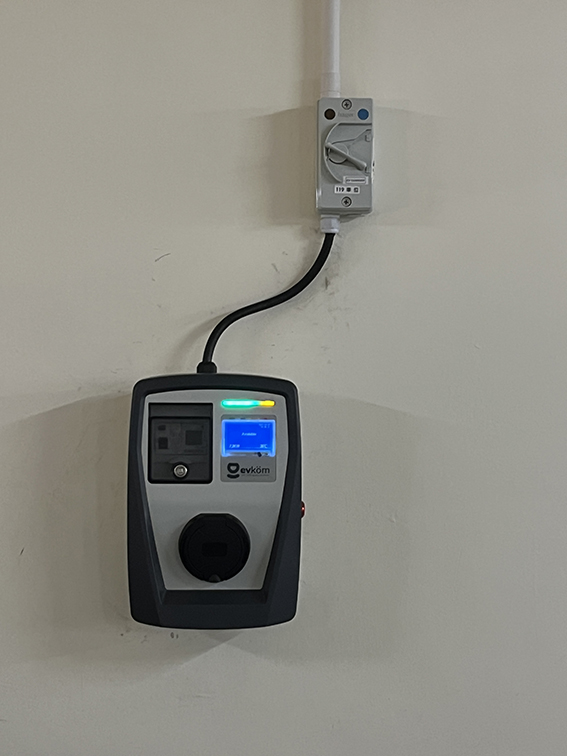 EV Charger with Built-in DC 6mA Residual Current Protection | 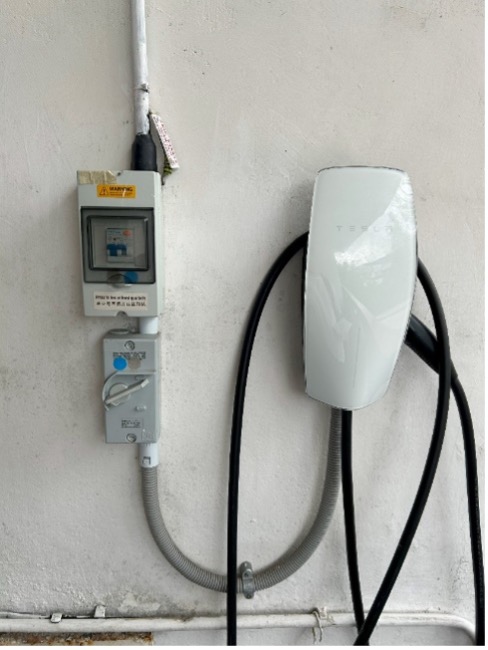 EV Charger without DC 6mA Residual Current Protection |
Q10. What are the procedures to install EV chargers and apply for tariff meters?
- Submit the Electricity Supply Application for EV Charging
- Complete and upload the “Confirmation of Agreement from Owner(s) of Rising Mains for Connection,” which has been signed by the Incorporated Owners.
- Pay deposit
- Schedule the charger installation
- Arrange an inspection appointment with power company
- Installation of the tariff meter upon power company’s acceptance
- Upon completion of installation, a WR1 completion certificate is issued.
- Successful installation and activation
For more information, please refer to the instructions from the power company.
HKE: Non-Residential Tariff - HK Electric
CLP: CLP 2025 Electricity Tariff Tables (Please refer to P.2 and P.8 of the tariff table)


